
What is an EDI 850? The Ultimate Guide to Electronic Purchase Orders
What is an EDI 850? The Ultimate Guide to the Electronic Purchase Order
Let's play a game. It's called "Purchase Order Pandemonium." You've just received a massive order from a new retail partner. The excitement is palpable, but so is the dread. The PO arrived as a 50-page PDF, and now your team is manually keying in every line item, SKU, and shipping address into your ERP. The risk of a typo, a missed detail, or a simple human error hangs heavy in the air, threatening chargebacks, shipping delays, and a damaged relationship with your new partner. Sound familiar?
For decades, this manual, error-prone process has been the silent tax on B2B commerce. But what if there was a better way? What if you could eliminate the paperwork, automate the data entry, and ensure 100% accuracy on every single order? That's the power of the EDI 850 Purchase Order, and today, we're pulling back the curtain on this transformative technology.
At crstl.ai, we believe that B2B trade should be as simple and seamless as e-commerce. We're building the Agentic OS for B2B Trade, and it all starts with understanding the foundational documents that make it all work. So, let's dive in.
What is an EDI 850 Purchase Order?
An EDI 850 Purchase Order is the electronic equivalent of a traditional paper purchase order. It is the most common and critical document in the Electronic Data Interchange (EDI) world, used by a buyer to place an order for goods or services from a supplier. Think of it as the digital handshake that kicks off the entire order-to-cash cycle.
This isn't just a digital file; it's a standardized format, governed by the ANSI X12 standard in North America and the EDIFACT ORDERS standard internationally. This standardization means that any two companies, regardless of their internal systems, can speak the same language and exchange order data seamlessly.
EDI 850 vs. Traditional Purchase Orders: A Quick Comparison
The difference between an EDI 850 and a paper or PDF-based purchase order is night and day. Here's a quick breakdown:
Deconstructing the EDI 850: A Look at the Segments
An EDI 850 document might look like a cryptic wall of text at first glance, but it's actually a highly structured file composed of segments and elements. Each segment acts like a line on a form, and each element is a specific piece of information.
Here are some of the most important segments you'll find in an EDI 850:
Annotated EDI 850 Sample
Here's a simplified example of what an EDI 850 looks like, with annotations to explain each part:
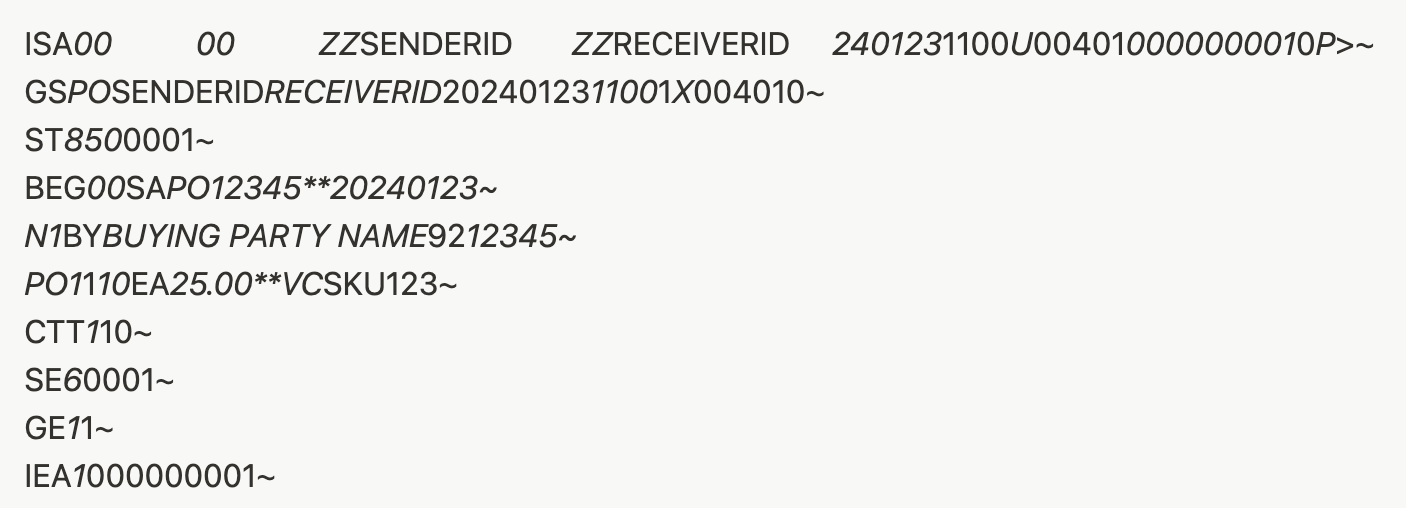
- ISA/GS/ST: The envelope and header, identifying the sender, receiver, and document type.
- BEG: This is a new, standalone purchase order (PO12345) created on January 23, 2024.
- N1: The buying party is "BUYING PARTY NAME" with an ID of 12345.
- PO1: This is the first line item, ordering 10 units (EA) of SKU123 at $25.00 each.
- CTT: There is 1 line item in this order, with a total quantity of 10 units.
- SE/GE/IEA: The trailer segments, closing out the document, group, and interchange.
The EDI 850 Workflow in Action
The EDI 850 is just the first step in a longer conversation between trading partners. Here's a typical workflow:
- Buyer sends EDI 850 (Purchase Order): The process begins.
- Seller sends EDI 997 (Functional Acknowledgment): The seller's system automatically confirms receipt of the 850.
- Seller sends EDI 855 (Purchase Order Acknowledgment): The seller confirms they can fulfill the order, suggests changes, or rejects it.
- Seller sends EDI 856 (Advance Ship Notice/ASN): Once the order is shipped, the seller sends an ASN with tracking information and shipment details.
- Seller sends EDI 810 (Invoice): The seller sends the electronic invoice to the buyer.
This automated workflow eliminates the need for manual follow-ups and provides real-time visibility into the order status for both parties.
The Future of EDI is Here, and It's Powered by AI
For too long, the conversation around EDI has been dominated by complexity, cost, and frustration. At crstl.ai, we're changing that. We believe that modern businesses need modern tools, and that's why we've built Edison AI, the world's first AI agent for EDI, directly into our platform.
Edison AI acts as your co-pilot for B2B trade, helping you:
- Validate documents in real-time: Catch errors before they become chargebacks.
- Understand trading partner requirements: No more digging through 100-page PDFs.
- Automate workflows: From order-to-cash, let AI handle the heavy lifting.
We're moving from an era of guesswork to an era of confidence. The debate isn't about how hard EDI is, but how easy it can be.
Frequently Asked Questions (FAQ)
What is the difference between an EDI 850 and an EDI 875?
The EDI 850 is a general purchase order used across all industries. The EDI 875 is a Grocery Products Purchase Order, specifically designed for the grocery industry with fields tailored to the unique needs of that sector.
How do I start using EDI 850?
The easiest way is to partner with a modern EDI provider like crstl.ai. We handle the technical complexity of connecting with your trading partners, so you can focus on growing your business.
Is EDI being replaced by APIs?
While APIs are great for real-time, flexible integrations, EDI remains the backbone of B2B commerce due to its security, reliability, and standardization. The future is a hybrid approach, where EDI and APIs work together, and crstl.ai is leading the charge.
Ready to Ditch the Paperwork?
If you're tired of "Purchase Order Pandemonium" and ready to embrace the speed, accuracy, and efficiency of modern EDI, we're here to help. Book a demo with crstl.ai today and see how our AI-powered platform can transform your B2B commerce operations.

Ready to simplify your operations?
Book a demo.svg)
