
Routing Guides in EDI: The Complete Guide to B2B Order Fulfillment Compliance
What Is a Routing Guide?
A routing guide is a retailer-issued document that tells suppliers exactly how, when, and where to ship orders to meet that retailer's logistics requirements. Every major retailer publishes one. It covers everything from which carriers to use and how to label cartons, to delivery appointment windows and required EDI documents. When a brand receives a purchase order (EDI 850) from a retailer like Walmart, Target, or UNFI, the routing guide is the instruction manual for fulfilling that order without triggering chargebacks or compliance penalties. According to industry estimates, manual order processing costs over $70 per transaction compared to less than $1 with automated EDI. A significant portion of those manual costs come from routing guide errors that lead to rejected shipments, redelivery fees, and penalty deductions. For growing brands shipping to multiple retailers, understanding and following routing guides is not optional. It is the difference between profitable retail relationships and margin-eroding compliance failures.
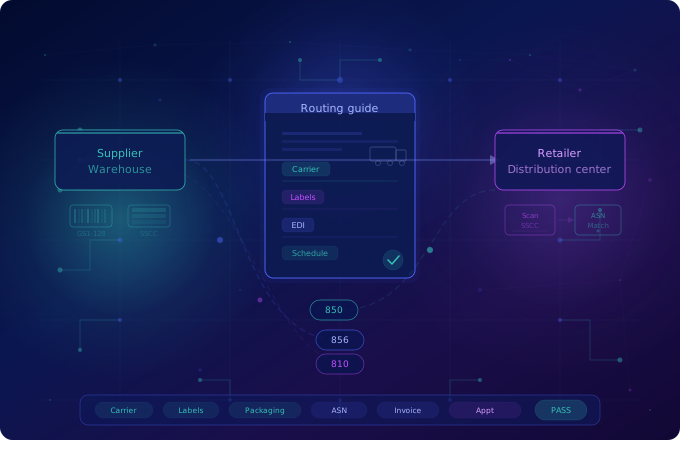
Definition: Routing Guide - A routing guide is a comprehensive logistics compliance document published by a retailer or distributor that specifies carrier assignments, shipping methods, packaging standards, labeling requirements, delivery scheduling procedures, and required EDI transaction sets that suppliers must follow when fulfilling purchase orders.
The Basics: Who Creates Routing Guides and Why
Every retailer has its own supply chain infrastructure. Walmart operates a different distribution network than Target, which runs a different setup than Kroger or Amazon. Routing guides exist because retailers need predictability. When thousands of suppliers are shipping into the same distribution centers, even small deviations in packaging, labeling, or delivery timing can cascade into costly disruptions.
The retailer's transportation and logistics team typically creates and maintains the routing guide. It gets updated periodically (sometimes quarterly, sometimes annually) to reflect changes in carrier contracts, DC locations, labeling standards, or compliance programs like Walmart's OTIF (On-Time In-Full) or Target's delivery performance metrics.
As a supplier, you are responsible for downloading, reading, and following the most current version of the routing guide for every retailer you ship to. Ignorance of an updated requirement is not a valid defense against chargebacks.
Routing Guides vs. Vendor Compliance Manuals
There is some overlap between routing guides and vendor compliance manuals, and brands often confuse the two. A vendor compliance manual is broader. It covers everything from how to set up your EDI connection and register as a supplier, to product data requirements, packaging specs, and payment terms. A routing guide is a subset focused specifically on transportation and logistics. It answers the question: once you have a purchase order, how do you physically get the product from your warehouse to the retailer's distribution center or store?
Some retailers combine both into a single document. Others publish them separately. Regardless, the routing guide portion is what your warehouse team, 3PL, and shipping department need to follow for every single order.
Why Do Retailers Enforce Routing Guides?
Retailers enforce routing guides because non-compliant shipments disrupt their entire supply chain, increase receiving costs, and create inventory availability gaps that directly hurt sales. A single supplier shipping on the wrong carrier or missing a delivery window does not just affect that one order. It backs up dock scheduling at the distribution center, forces manual receiving processes, delays inventory replenishment to store shelves, and creates a ripple effect across the retailer's logistics network. Walmart processes over 10,000 inbound shipments per day across its distribution network. Target operates 50+ distribution and fulfillment centers. UNFI manages temperature-controlled logistics for thousands of natural and organic products. At that scale, standardization is the only way to keep costs down and products flowing. Routing guides are the mechanism that makes standardization possible, and chargebacks are the mechanism that makes compliance non-negotiable.
Cost Control and Operational Efficiency
Retailers negotiate freight contracts at massive scale. When a routing guide specifies that you must use a particular carrier for collect shipments, it is because the retailer has negotiated volume rates with that carrier. If you ship on a different carrier, the retailer loses that negotiated rate and absorbs a higher cost. Routing guides help retailers consolidate inbound freight across multiple suppliers into efficient delivery patterns, reducing the number of partial truckloads and maximizing DC throughput.
Receiving Accuracy and Speed
Distribution centers run on tight schedules. Every dock door is assigned by appointment, every inbound load is expected at a specific time, and receiving teams are staffed based on projected volume. When a shipment arrives without proper labeling, without the correct ASN (EDI 856), or outside the scheduled window, it requires manual intervention. That manual intervention slows down receiving for every other shipment behind it. Routing guide compliance keeps the assembly line moving.
Inventory Availability
The ultimate goal of retail logistics is getting product on the shelf when customers want to buy it. Late shipments, short shipments, and shipments that get rejected at the dock all contribute to out-of-stock conditions. Out-of-stocks cost retailers an estimated 4% of annual sales. Routing guides exist, in part, to minimize the gap between when a purchase order is issued and when that product is available for sale.
What Does a Routing Guide Include?
A routing guide typically includes carrier assignments, shipping method requirements, delivery appointment scheduling procedures, packaging and palletization standards, labeling specifications (including GS1-128 and SSCC barcodes), and a list of required EDI documents that must accompany every shipment. The specifics vary by retailer, but the core categories are consistent across the industry. Suppliers who ship to multiple retailers will recognize the same structural sections in every routing guide they read, even though the actual requirements differ. The challenge is not understanding what a routing guide covers. The challenge is tracking the differences between five, ten, or twenty routing guides simultaneously and making sure your warehouse processes, labels, and EDI transactions are configured correctly for each one.
Carrier Assignment and Freight Terms
One of the most critical sections of any routing guide is the carrier assignment. Retailers typically operate under two freight models: collect (the retailer pays for shipping and specifies the carrier) and prepaid (the supplier pays and can choose the carrier within guidelines). For collect shipments, the routing guide will list specific carriers by Standard Carrier Alpha Code (SCAC) and provide account numbers that suppliers must reference when booking freight. Using any carrier other than the one assigned is a compliance violation.
For prepaid shipments, the routing guide usually still imposes constraints. You might have flexibility on carrier choice, but the routing guide will specify requirements for delivery appointment scheduling, transit time windows, and documentation that must accompany the shipment regardless of who pays.
Packaging and Palletization
Routing guides get extremely specific about how product should be packed and palletized. Common requirements include standard 48x40 GMA pallet dimensions, maximum stacking height (often 48 or 60 inches), no overhang beyond the pallet edge, stretch wrap specifications, and tier sheet requirements between layers. Some retailers require specific case pack quantities or inner pack configurations that align with their shelf replenishment processes.
For brands selling into grocery and natural channels (UNFI, KeHE), there are additional temperature and handling requirements that vary by product category. Frozen, refrigerated, and ambient products each have distinct palletization and shipping rules.
Labeling: GS1-128, SSCC, and Beyond
Labeling is where many brands first experience routing guide chargebacks. Every carton and pallet must carry compliant GS1-128 labels with Serial Shipping Container Codes (SSCCs) that match the data in your EDI 856 ASN. The label placement, format, and data content are all specified in the routing guide. Labels must be scannable, positioned on the correct face of the carton, and include the right Application Identifiers (AIs) for SSCC, GTIN, batch/lot, quantity, and ship-to location.
If the label on the carton does not match the ASN data, the retailer's receiving system will flag the discrepancy. Depending on the retailer, that can mean a chargeback, a delay in receiving, or both.
How Do Routing Guides Connect to EDI?
Routing guides and EDI are inseparable in modern B2B fulfillment because every physical shipment must be accompanied by corresponding electronic documents that retailers use to verify compliance, schedule receiving, and update inventory systems. The routing guide tells you what to ship and how to ship it. EDI tells the retailer that you have shipped it, what is in the shipment, and when it will arrive. Without accurate, timely EDI transactions, even a perfectly packaged and correctly routed shipment can trigger compliance failures. The EDI 856 Advance Ship Notice is the single most routing-guide-dependent EDI document. It must contain shipment-level, order-level, and item-level data that maps directly to your physical shipment, including carrier SCAC codes, tracking numbers, SSCC numbers from your GS1-128 labels, and delivery dates that align with your scheduled appointment.
The EDI Transaction Flow for Order Fulfillment
The typical order fulfillment cycle involves multiple EDI transactions, each of which interacts with the routing guide:
Why ASN Accuracy Is the Linchpin
The ASN is where routing guide compliance and EDI accuracy converge. When the shipment arrives at the retailer's DC, the receiving team scans the GS1-128 labels on each carton and pallet. The system cross-references those scans against the ASN data. If the SSCC on the label does not appear in the ASN, the carton is flagged. If the ASN says 100 units but the physical count is 95, that is a variance. If the ASN was transmitted after the shipment arrived (or not at all), the entire load may be received manually at a penalty.
For brands working with a 3PL, this is especially critical. Your 3PL's warehouse management system must generate labels and ASN data from the same source of truth. Any disconnect between the physical fulfillment process and the electronic data transmission creates chargeback risk.
Struggling to keep your ASN data in sync with your shipping labels? Crstl's platform automates the connection between your WMS, labeling, and EDI transactions so that every carton label, pallet label, and ASN are generated from a single data source. No manual data entry. No mismatches.
Retailer Routing Guide Requirements: A Comparison
Every major retailer publishes its own routing guide with unique requirements, and the differences between them are significant enough that suppliers cannot use a one-size-fits-all approach. What works for Walmart will not work for Target. What satisfies UNFI will not necessarily satisfy Walmart. Brands that ship to five or more retailers are effectively managing five different compliance programs simultaneously, each with its own carriers, labeling formats, appointment systems, and chargeback structures. The table below highlights the key differences across several major retailers that growing brands commonly ship to. Note that routing guide details change frequently, so always reference the retailer's most current published version.
Walmart Routing Guide Highlights
Walmart's routing guide is among the most detailed in the industry. Their OTIF program measures suppliers on two dimensions: on-time delivery (within a specific window around the scheduled date) and in-full shipment (the correct quantity against the PO). Falling below Walmart's OTIF targets triggers financial penalties that are calculated as a percentage of the cost of goods. Walmart requires suppliers to use their designated carriers for collect freight and provides carrier assignments through Retail Link. For more detail, see our Walmart EDI requirements guide.
Target Routing Guide Highlights
Target's routing guide emphasizes delivery accuracy and timeliness through their performance scorecard in Target Partners Online. Target uses a collect freight model for most purchase orders and assigns carriers through their transportation management system. Labeling, ASN accuracy, and delivery window compliance are the primary areas where brands encounter chargebacks. See our Target EDI requirements guide for a full breakdown.
Amazon Routing Guide Highlights
Amazon's routing guide varies depending on whether you are in Vendor Central, Seller Central, or a hybrid model. Amazon's fulfillment center network has unique labeling requirements, and their PO confirmation and ASN processes are tightly coupled. Amazon-specific barcode formats and packaging requirements add an extra layer of complexity for brands that also ship to brick-and-mortar retailers.
What Happens When You Violate a Routing Guide?
Routing guide violations result in financial chargebacks, shipment refusals, delivery delays, and damaged supplier scorecards that can ultimately cost you shelf space or the retailer relationship entirely. The financial impact alone is significant. Industry data suggests that EDI chargebacks cost suppliers anywhere from $10,000 to $50,000 per month depending on order volume and retailer severity. But the less visible consequences are equally damaging. A pattern of routing guide violations signals to the retailer that you are an unreliable supplier. That affects promotional opportunities, planogram placement, replenishment priority, and whether your products get reordered at all. For emerging brands trying to build a foothold in retail, a few months of poor compliance can undo years of work getting on the shelf.
Common Routing Guide Violations and Their Costs
The Compound Effect of Chargebacks
Individual chargebacks are annoying. Repeated chargebacks are existential. Most retailers track supplier compliance over rolling periods (typically 3-6 months) and use that data to make assortment decisions. If your compliance score drops below the retailer's threshold, you may face increased chargeback rates, reduced order volume, or even discontinuation. This is why routing guide compliance is not just a logistics problem. It is a business problem that affects revenue, margin, and growth trajectory.
For a deeper look at chargeback prevention strategies, see our comprehensive guide on how to avoid EDI chargebacks.
How to Stay Compliant with Routing Guides
Staying compliant with routing guides requires a combination of centralized documentation, warehouse process alignment, accurate EDI transactions, and ongoing monitoring of retailer updates. No single tool or checklist solves routing guide compliance on its own. It is a cross-functional effort that spans your operations team, your warehouse (or 3PL), your EDI system, and your account management relationships with each retailer. Brands that treat routing guide compliance as a one-time setup rather than an ongoing process are the ones that accumulate chargebacks. The most effective approach is to build compliance into your fulfillment workflow so that every order is routed, packed, labeled, and documented correctly by default.
Step 1: Build a Retailer Compliance Matrix
Create a master document that captures the key routing guide requirements for every retailer you ship to. Include carrier assignments, labeling specs, ASN timing requirements, appointment scheduling procedures, and any retailer-specific quirks. Update this matrix every time a retailer publishes a new version of their routing guide. This becomes the reference document for your warehouse team and your EDI configuration.
Step 2: Configure Your EDI System Per Retailer
Your EDI platform should be configured to generate retailer-specific ASNs, invoices, and PO acknowledgments that meet each routing guide's data requirements. This means different field mappings, different timing rules, and different validation checks for each trading partner. A platform like Crstl handles this by maintaining retailer-specific compliance profiles that automatically apply the correct rules when you process an order for that retailer.
Step 3: Align Your Warehouse (or 3PL) Processes
Your warehouse needs to know how to pick, pack, palletize, and label orders differently based on which retailer the order is for. This includes generating the correct GS1-128 labels with SSCC barcodes, applying labels in the right position, using the correct pallet configuration, and preparing the right documentation. If you use a 3PL, make sure they have a copy of each routing guide and that their WMS is configured to enforce the right rules per retailer.
Step 4: Automate Appointment Scheduling
Many routing guide violations happen before the product even leaves the warehouse. Missing a delivery appointment or failing to schedule one at all is a common and easily preventable mistake. Automate appointment scheduling through the retailer's portal or transportation management system, and build reminders into your workflow so that appointments are confirmed before shipment.
Step 5: Monitor and Audit
Set up a process to regularly review your compliance scorecards from each retailer. Most retailers provide performance dashboards through their supplier portals (Retail Link for Walmart, Partners Online for Target, Vendor Central for Amazon). Track your scores, investigate any chargebacks, and identify recurring issues. The patterns in your chargeback data will tell you exactly where your process is breaking down.
Routing Guide Compliance with AI and Automation
AI-powered EDI platforms are transforming routing guide compliance by automating the most error-prone parts of the process: document generation, label-to-ASN matching, field validation, and retailer-specific rule enforcement. The traditional approach to routing guide compliance relied on manual processes. Someone in operations would read the routing guide, configure the warehouse process, set up the EDI mappings, and hope that nothing changed. When the retailer updated their routing guide, someone had to catch the update, interpret the changes, and propagate them across every system in the fulfillment chain. That approach does not scale. When you are shipping to two retailers, manual compliance management is feasible. When you are shipping to ten, it is a full-time job. When you are shipping to twenty, it is a liability. AI and automation address this in several ways.
Automated Document Generation
Modern EDI platforms generate ASNs, invoices, and PO acknowledgments directly from order and shipment data, eliminating manual data entry. When your warehouse completes a shipment, the platform automatically generates the ASN with the correct carrier codes, tracking numbers, SSCC data, and item details. No one has to manually key in ASN data or copy-paste from a spreadsheet.
Retailer-Specific Validation
AI-powered platforms maintain compliance profiles for each retailer. When you process an order for Walmart, the system validates your ASN against Walmart's requirements. When you process an order for Target, it applies Target's rules. This happens automatically without requiring your team to remember the differences between routing guides.
Intelligent Error Detection
Instead of discovering compliance issues through chargebacks (weeks after the fact), AI-powered platforms flag potential violations before the shipment leaves the warehouse. Missing label data, ASN field errors, carrier mismatches, and timing violations are caught in real-time so they can be corrected before they become costly.
Continuous Updates
The best platforms stay current with retailer requirements. When a retailer publishes a new routing guide or updates their compliance rules, the platform's retailer profiles are updated accordingly. This removes the burden of manually tracking routing guide changes across all your trading partners.
Ready to automate your routing guide compliance? Crstl combines AI-powered EDI with built-in retailer compliance profiles, automated labeling, and real-time validation to help brands ship every order right the first time.
Frequently Asked Questions
What is a routing guide in B2B fulfillment?
A routing guide is a retailer-issued document that specifies how suppliers must ship orders, including carrier assignments, packaging standards, labeling requirements, delivery scheduling, and required EDI documents. Every major retailer publishes a routing guide, and suppliers are required to follow it for every shipment.
How does a routing guide relate to EDI?
Routing guides and EDI work together in the order fulfillment process. The routing guide defines the physical shipping requirements, while EDI documents (especially the EDI 856 ASN) provide the electronic data that retailers use to verify compliance, schedule receiving, and update inventory. ASN data must match routing guide requirements exactly.
What happens if I violate a retailer's routing guide?
Violations typically result in financial chargebacks ($100 to $1,000+ per occurrence depending on the retailer and violation type), shipment refusals, delivery delays, and negative impacts on your supplier compliance scorecard. Repeated violations can lead to reduced order volume or loss of the retailer account.
Do all retailers have routing guides?
Yes. Every major retailer and distributor publishes a routing guide or equivalent logistics compliance document. This includes Walmart, Target, Amazon, Kroger, Costco, UNFI, KeHE, Nordstrom, and others. Requirements vary significantly between retailers, so brands must track compliance requirements for each trading partner separately.
How often do routing guides change?
Routing guides are typically updated one to four times per year. Some retailers publish major annual updates, while others make incremental changes throughout the year. It is the supplier's responsibility to stay current with the latest version. Retailers usually announce updates through their supplier portals.
Can my 3PL handle routing guide compliance for me?
A good 3PL will follow routing guide requirements for physical shipment preparation (packaging, palletization, labeling), but you remain responsible for ensuring that your EDI transactions are accurate, timely, and compliant. The EDI side (ASN timing, data accuracy, field mapping) typically remains the brand's responsibility or is handled by the brand's EDI provider.
What is the difference between a routing guide and a vendor compliance manual?
A vendor compliance manual covers the full scope of the supplier-retailer relationship, including EDI setup, product data, packaging, payment terms, and more. A routing guide is specifically focused on transportation and logistics. It tells you how to ship orders after you receive a purchase order. Some retailers combine both into a single document.
How does Crstl help with routing guide compliance?
Crstl maintains retailer-specific compliance profiles that automatically apply the correct EDI mapping rules, field validation, labeling requirements, and document timing for each trading partner. Combined with AI-powered error detection and automated ASN generation, Crstl helps brands avoid routing guide chargebacks and stay compliant across all their retail relationships. See how it works →
Conclusion
Routing guides are the operational backbone of B2B order fulfillment. They define how every shipment moves from your warehouse to the retailer's distribution center, and compliance with them directly affects your chargeback exposure, your supplier scorecard, and your ability to grow your retail footprint. For brands shipping to multiple retailers, the complexity compounds with every new trading partner added.
The key to managing routing guide compliance at scale is automation. Manual tracking of carrier assignments, labeling specs, ASN timing, and appointment scheduling across multiple retailers is unsustainable for growing brands. An AI-powered EDI platform that maintains retailer-specific compliance profiles, generates accurate documents automatically, and catches errors before shipment is the most effective way to protect your margins and your retailer relationships.
Need help managing routing guide compliance across your retail partners? Crstl's AI-powered EDI platform automates document generation, labeling, and retailer-specific validation so you can focus on growing your brand instead of chasing chargebacks.

Ready to simplify your operations?
Book a demo.svg)
